
bind() writes a static site, and a static site runs on anything that can serve files. Upload the whole _site/ directory, dot files included.
Cross-origin isolation
webR runs fastest on pages served with two headers. They are tedious to spell and worth the trouble.
Cross-Origin-Opener-Policy: same-origin
Cross-Origin-Embedder-Policy: require-corp
Without them webR still works, on a slower channel where Ctrl+C cannot interrupt R, and readline(), menu() and browser() do not work. The console says so and points at the Restart R button, which restarts R with the site’s packages, files and startup script. The editor’s files survive a restart, and the session’s objects do not. Requests made with curl or httr2 need the headers too (HTTP requests).
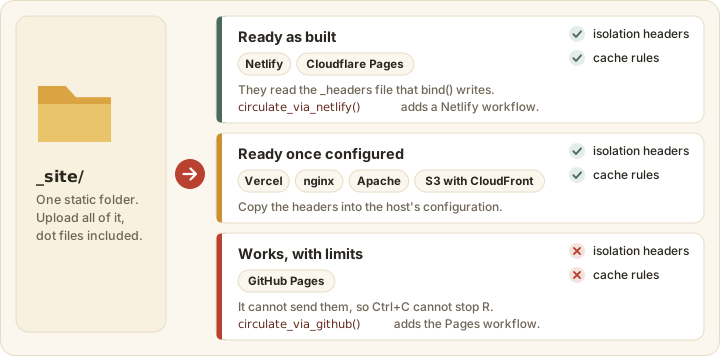
Hosts differ in whether they send the headers.
| Host | Sends the headers? | How |
|---|---|---|
| Netlify | yes | the _headers file bind() writes into the site |
| Cloudflare Pages | yes | the same _headers file |
| Vercel, nginx, Apache, S3 with CloudFront | yes, once configured | your own configuration (below) |
| GitHub Pages | no | GitHub Pages cannot set response headers |
| GitLab Pages | only if the instance’s administrator adds them | the instance’s configuration |
reading_room() |
yes | always |
HTTP requests
A browser gives WebAssembly no network sockets, so R reaches other servers in two ways.
-
download.file()and functions that read a URL, such asreadLines()andread.csv(), work on every host. They only fetch (aGETrequest), and only from servers that allow requests from other sites (CORS), as GitHub’s API andraw.githubusercontent.comdo. - curl and httr2 send any request to any server, from a page served with the isolation headers. curl 7.1.0 and later pass the connection through a public WebSocket proxy,
ws.r-universe.dev, with nothing to set up. The proxy sees which server a request goes to, and an HTTPS request stays encrypted between R and that server.
Without the headers a curl or httr2 request waits ten seconds and fails.
Failed to perform HTTP request.
Caused by error in `curl::curl_fetch_memory()`:
! Timeout was reached [api.github.com]:
Connection timed out after 10000 milliseconds
GitHub Pages
One call writes the workflow.
This writes .github/workflows/deploy-webr.yml. On every push to main or master the workflow installs the webrarian release that wrote it, runs bind(), and publishes with GitHub’s Pages actions. Pull requests build without publishing. Three steps turn it on.
- Commit and push the workflow.
- In Settings > Pages, set Source to GitHub Actions.
- Open the site at
https://<user>.github.io/<repository>/.
overwrite = TRUE replaces an existing workflow. For a custom domain, set it in Settings > Pages > Custom domain (a CNAME file is ignored).
GitHub Pages sends neither the isolation headers nor caching headers, so sites there run without Ctrl+C and without curl or httr2 requests (HTTP requests). The service worker helps with repeat visits.
Netlify
Netlify takes one call too.
This writes two files. netlify.toml tells Netlify to publish _site/ and sets no headers. .github/workflows/netlify-deploy.yml builds on GitHub, because Netlify’s build image has no R, and deploys with the Netlify CLI. Add two repository secrets, NETLIFY_AUTH_TOKEN and NETLIFY_SITE_ID.
Every header the site needs is in _site/_headers, so a manual deploy (dragging _site/ onto https://app.netlify.com/drop) gets the same headers. If you keep your own netlify.toml with [[headers]] rules, bind() leaves those paths out of _headers.
Cloudflare Pages
Publish _site/ as the output directory. Cloudflare reads _headers, so nothing else is needed.
Other hosts
Send the two isolation headers with every response, copy the cache rules from _site/_headers (see Caching), and serve .wasm as application/wasm. Vercel reads vercel.json in the published directory.
{
  "headers": [
    {
      "source": "/(.*)",
      "headers": [
        { "key": "Cross-Origin-Opener-Policy", "value": "same-origin" },
        { "key": "Cross-Origin-Embedder-Policy", "value": "require-corp" }
      ]
    }
  ]
}
nginx drops the server’s add_header lines in any location that adds its own, so repeat them.
server {
    listen 443 ssl;
    server_name r.example.com;
    root /var/www/my-site;

    add_header Cross-Origin-Opener-Policy "same-origin" always;
    add_header Cross-Origin-Embedder-Policy "require-corp" always;
    add_header Cache-Control "no-cache" always;

    location ~ ^/(webr/|exlibris-r\.|library/) {
        add_header Cross-Origin-Opener-Policy "same-origin" always;
        add_header Cross-Origin-Embedder-Policy "require-corp" always;
        add_header Cache-Control "public, max-age=31536000, immutable" always;
    }
}
For S3, put CloudFront in front with a response headers policy. Sites work from a sub-path (https://example.com/tools/r/). Outside localhost and 127.0.0.1, serve over HTTPS.
Offline sites
With build.offline: true the page contacts no other server. bind() copies the engine and every package into the site and does not link a brand’s Google or Bunny fonts (fonts with source: file still work). Visitors can install only bundled packages. The site then runs on a network with no internet access (Managing Packages).
License notices
Every site lists what it redistributes in LICENSES/.
| File | Covers |
|---|---|
webrarian.md |
webrarian’s output exception, which makes the files webrarian generates yours to license |
exlibris.md |
the exlibris viewer’s AGPL-3 license, the runtime exception that lets you publish the unmodified bundle, and a source link |
THIRD-PARTY-r.md |
the third-party code inside the viewer |
webR.md |
the webR engine’s licenses (GPL-3 for R, MIT for the JavaScript client) |
PACKAGES.md |
every bundled R package with its version, license and source |
index.html |
a page linking the files above |
Bundled packages are distributed under their own licenses. When you bundle a local package under a GPL-family license, bind() reminds you that its source must be available, for example by publishing it on GitHub and bundling it from there.
Caching
Files named after their content are kept for a year, the rest are rechecked, and _site/_headers carries the rules.
| Path | Cache rule | Why |
|---|---|---|
webr/v<version>/ |
kept for a year, never rechecked | a new webR version is a new directory |
exlibris-r.<hash>.js, .css
|
kept for a year, never rechecked | the name changes with the content |
library/library-<hash>.tgz |
kept for a year, never rechecked | the name changes with the packages |
index.html, vfs-files/, repo/, LICENSES/, packages.json, sw.js
|
rechecked on every visit | rewritten by every build at the same URL |
Rechecking (Cache-Control: no-cache) costs a short “not modified” answer, not a download. Netlify and Cloudflare Pages apply _headers, and elsewhere you copy the rules.
The service worker
Hosts that send no caching headers, such as GitHub Pages, can lean on a service worker.
# _webrarian.yml
build:
  service-worker: true
bind() writes _site/sw.js, which caches the engine, viewer and library image (their URLs change with their content) and fetches the page and files from the network first. It speeds up repeat visits but does not make the site work offline. Every build without the option writes an sw.js that removes an earlier worker. Visitors with the page open see changes after a reload. To debug, use “Update on reload” under Application > Service workers in the browser’s developer tools.
Other CI services
Any CI that runs R can build the site. Here is the job for GitLab.
# .gitlab-ci.yml
pages:
  image: rocker/r-ver:4.6
  script:
    - Rscript -e 'install.packages("webrarian", repos = c("https://coatless-wasm.r-universe.dev", "https://cloud.r-project.org"))'
    - Rscript -e 'webrarian::bind()'
    - mv _site public
  artifacts:
    paths:
      - public
  rules:
    - if: $CI_COMMIT_BRANCH == $CI_DEFAULT_BRANCH
Collections with local or GitHub packages also need Docker in the job.
Failed deployments
Work through these checks when a deployed site fails.
- Look for 404s in the browser’s developer tools, which usually mean files were left out of the upload.
- Rule out the isolation headers. Missing ones slow webR and disable Ctrl+C but do not stop the site.
- Check that the site is served over HTTPS.
See also Troubleshooting.