
system.file("viewer", "PROVENANCE.json", package = "webrarian")
system.file("viewer", "THIRD-PARTY.md", package = "webrarian")
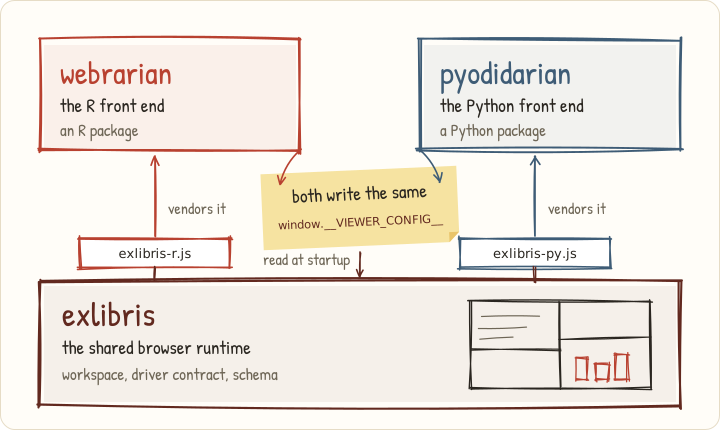
system.file("viewer-config.schema.json", package = "webrarian")webrarian has two halves, and only one of them is written in R. The R half models a collection, fetches WebAssembly packages, copies files and writes the site. The browser half is exlibris, a separate project whose prebuilt JavaScript bundle ships in inst/viewer/ and is copied into every site. You need no Node and no JavaScript toolchain.
Responsibilities
webrarian owns _webrarian.yml, package resolution, Docker compilation, the engine cache, deployment helpers and collection_mirror(). exlibris owns the page once it loads, including the workspace panels, the webR driver (startup, package installs or the mounted library image, the file system, plots, help, restarts), share links, stored edits, the exlibris-embed/1 protocol and the sanitizer for rich output.
Your installed webrarian pins the viewer, so a newer viewer means a newer webrarian. webr.version selects only the R engine.
The shared contract
bind() writes one ViewerConfig object into index.html, above the script that loads the bundle.
<script>window.__VIEWER_CONFIG__ = {"schema-version":1,"engine":"webr", ... };</script>For a collection with two packages and one file, part of it reads as follows.
{
  "schema-version": 1,
  "engine": "webr",
  "engine-version": "0.6.0",
  "engine-base-url": "./webr/v0.6.0/",
  "packages": {
    "install": ["dplyr", "ggplot2"],
    "repos": ["https://repo.r-wasm.org"],
    "repo-url": "./repo",
    "library-images": ["./library/library-<hash>.tgz"]
  },
  "files": [
    {
      "name": "analysis.R",
      "vfs-path": "/home/web_user/analysis.R",
      "fetch-path": "vfs-files/analysis.R"
    }
  ],
  "mount-point": "/home/web_user",
  "auto-open": ["/home/web_user/analysis.R"],
  "share-links": "open",
  "persist-edits": true
}
engine-base-url is the site’s own engine, or https://webr.r-wasm.org/v0.6.0/ with build.bundle-engine: false. Packages come from the mounted library-images, or failing that from repo-url, then repos. An offline site adds "offline": true with an empty repos. A short script after the object makes its URLs absolute, which is why sites work from a sub-path.
exlibris defines the object’s shape as a TypeScript type and a JSON Schema. webrarian builds the object independently in R, so it vendors the schema as inst/viewer-config.schema.json and its tests validate real builds against it. Unknown fields are rejected.
Auditing the prebuilt bundle
A minified bundle is hard to read, so inst/viewer/ carries what you need to check it.
| File | What it is |
|---|---|
exlibris-r.js, exlibris-r.css
|
the bundle, minified |
index.html |
the page bind() fills in |
PROVENANCE.json |
the exlibris commit and ref, and a SHA-256 for every vendored file |
THIRD-PARTY.md |
every npm package in the bundle, with its version, license and nested notices |
EXCEPTION.md |
the exlibris runtime exception |
LICENSE.webR.md |
the webR notice |
This installation’s bundle comes from exlibris v0.1.3, commit 04767100e2f6, and embeds version 0.6.0 of the webR JavaScript client.
webrarian’s tests re-hash each installed file against PROVENANCE.json, and CI rebuilds exlibris at the recorded commit and compares the result. Of webR, the bundle holds only the JavaScript client. The WebAssembly build of R is copied into the site or loaded from webr.r-wasm.org, as LICENSES/ records.
The Python counterpart
pyodidarian, released separately, does for Python and Pyodide what webrarian does for R. It uses the same exlibris workspace, the same function names (catalog(), acquire_package(), bind(), reading_room(), collection_mirror()) and the same keys in _pyodidarian.yml wherever the languages agree. webrarian’s functions differ from pyodidarian’s in these ways.
-
bind()has noupgradeorlockedargument, because webrarian keeps no lock file. -
collection_mirror()also takesreposandfavicon. -
reading_room(watch = TRUE)needsblock = TRUE. -
reading_room()’sopen_browserdefaults torlang::is_interactive(). -
check_inventory()returns a data frame rather than a list of rows. -
acquire_package()adds a prebuilt package that no repository has, with a warning, where pyodidarian’s refuses it. -
webr_cache_clear()asks before clearing everything in an interactive session, but pyodidarian’spyodide_cache_clear()never asks. -
collection_mirror()returns the mirror’s directory, invisibly, rather than a bind result. -
diagnose_collection()files each problem under anareaof"network","config","tools"or"packages", while pyodidarian uses its own areas.
exlibris, webrarian and pyodidarian are released under AGPL-3. exlibris’s exception lets you publish its unmodified bundle in a generated site, and webrarian’s exception covers the files it generates, so a site you build is yours to license.